Osgood Schlatter vs Sinding Larsen Johansson: Understanding the Difference

Your child has knee pain. The doctor mentions it could be Osgood Schlatter or Sinding Larsen Johansson syndrome. Both names sound complicated, and both affect young athletes' knees. So what's the difference—and does it actually matter?
The short answer: these are two distinct conditions affecting different parts of the knee, though they share similar causes and treatment approaches. Understanding which one your child has helps you know exactly what's happening and how to address it effectively.
This guide breaks down both conditions, explains how to tell them apart, and covers what you need to know about treatment for each.
Osgood vs SLJ The Quick Comparison
Before diving into details, here's the essential difference:
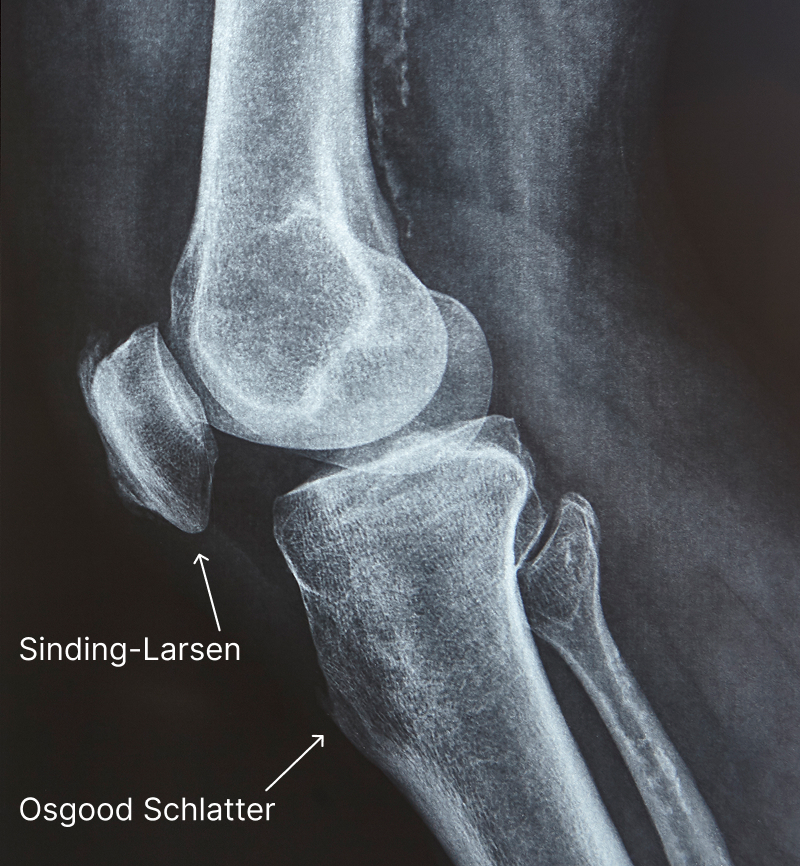
Both conditions involve the patellar tendon—they just affect different ends of it. Think of the patellar tendon as a rope connecting the kneecap to the shin bone. Osgood Schlatter affects where the rope attaches to the shin. Sinding Larsen Johansson affects where it attaches to the kneecap.
Osgood Schlatter Disease (OSD)
Osgood Schlatter Disease is a growth-related overuse injury affecting the tibial tuberosity—the bony bump at the top of the shin bone, just below the kneecap.
How it develops:
During rapid growth spurts, the thigh bone (femur) grows faster than the quadriceps muscle can adapt. This creates excessive tension on the patellar tendon, which pulls repeatedly at its attachment site on the tibial tuberosity. Because this attachment site is still partly cartilage in growing teenagers (an open growth plate), the repeated stress causes inflammation, pain, and eventually a characteristic bony bump.
Key characteristics:
- Pain located 2-3 cm below the bottom of the kneecap
- Visible or palpable bump at the top of the shin bone
- Bump is typically tender to touch
- Pain worsens with running, jumping, kneeling, and stairs
- Most common in ages 10-15 (girls 10-13, boys 12-15)
- Affects approximately 12% of active young athletes
- Can occur in one knee (unilateral) or both knees (bilateral)
The hallmark sign of Osgood Schlatter is that characteristic bump below the kneecap. If your child points to the top of their shin bone and you can see or feel a prominent bump there, it's very likely Osgood Schlatter.
What Is Osgood Schlatter Disease - Complete Guide →
Sinding Larsen Johansson Syndrome (SLJ)
Sinding Larsen Johansson (SLJ) syndrome is a growth-related injury affecting the inferior pole of the patella—the bottom tip of the kneecap itself, where the patellar tendon attaches.
How it develops:
The mechanism is nearly identical to Osgood Schlatter. During growth spurts, tight quadriceps muscles create excessive tension on the patellar tendon. But instead of causing problems at the shin bone attachment (like Osgood), the stress affects the kneecap attachment. The growth plate at the bottom of the kneecap becomes irritated and inflamed from the repeated pulling forces.
Key characteristics:
- Pain located at the bottom tip of the kneecap itself
- Usually no visible bump (or only slight swelling)
- Tender to touch at the inferior pole of the patella
- Pain worsens with similar activities: running, jumping, kneeling, stairs
- Most common in ages 10-14
- Less common than Osgood Schlatter
- Also can occur unilaterally or bilaterally
How to pronounce it: SIN-ding LAR-sen YO-han-son
Like Osgood Schlatter, this condition is named after the physicians who first described it: Sinding-Larsen (a Norwegian physician) and Johansson (a Swedish physician), who independently documented the condition in the 1920s (a very similar story to Osgood whcih was discovered and described independently in the same year!)
How to Tell Osgood and SLJ Apart
The key difference is location. Both conditions cause anterior knee pain that worsens with activity, but they affect different anatomical structures.
The Simple Test:
Ask your child to point to exactly where it hurts:
If they point BELOW the kneecap (at the bony bump on the shin):→ Likely Osgood Schlatter
If they point to the BOTTOM of the kneecap itself (the tip of the kneecap):→ Likely Sinding Larsen Johansson
Visual and Physical Differences:
Osgood Schlatter:
- Obvious bump below the kneecap that you can see and feel
- The bump is on the shin bone, not the kneecap
- Bump often becomes more prominent over time if untreated
- Tenderness when pressing on the tibial tuberosity
Sinding Larsen Johansson:
- Usually no visible bump (may have slight swelling)
- Pain is directly at the bottom edge of the kneecap
- May have some soft tissue swelling but not bony prominence
- Tenderness when pressing on the inferior pole of the patella
The Anatomy:
Imagine the patellar tendon as a bridge:
- The kneecap (patella) is on one end
- The tibial tuberosity (shin bone bump) is on the other end
- The patellar tendon connects them
Both conditions involve this same tendon, but:
- SLJ = problem at the kneecap end of the bridge
- Osgood Schlatter = problem at the shin bone end of the bridge
Can You Have Both OSD and SLJ at the Same Time?
Yes, though it's relatively uncommon. Some young athletes develop both Osgood Schlatter and Sinding Larsen Johansson simultaneously, particularly those who:
- Are in the middle of rapid growth spurts
- Have very tight quadriceps muscles
- Participate in high-volume jumping sports
- Have significant muscle weakness relative to their activity demands
When both conditions occur together, the athlete will have tenderness at both locations—the bottom of the kneecap AND the top of the shin bone. Treatment addresses the same underlying causes (tight muscles, weak stabilizers, excessive load), so the rehabilitation approach is similar regardless of which condition—or both—is present.
Comparing Causes and Risk Factors
Both Osgood Schlatter and Sinding Larsen Johansson share nearly identical causes:
Shared Causes:
- Rapid bone growth outpacing muscle adaptation
- Tight quadriceps muscles creating excessive tendon tension
- Repetitive stress from running, jumping, and sport
- Open growth plates that are vulnerable to traction forces
- High training volumes without adequate recovery
Shared Risk Factors:
- Active in jumping/running sports (basketball, volleyball, soccer, track)
- Currently experiencing a growth spurt
- Taller children who grow quickly
- Year-round sport participation
- Weak hip and glute muscles
- Poor landing and movement mechanics
Slight Differences:
Osgood Schlatter tends to be:
- Slightly more common overall
- Peak incidence slightly later (12-15 for boys)
- More likely to leave a permanent bump
Sinding Larsen Johansson tends to be:
- Slightly less common
- Peak incidence slightly earlier (10-14)
- Less likely to leave visible changes
However, these differences are subtle. The two conditions are essentially the same injury affecting different ends of the same tendon system.
Diagnosis: How Doctors Tell the Difference
Both conditions are typically diagnosed through physical examination and questioning with a physical therapist or sports doctor rather than imaging.
Physical Examination:
The doctor will:
- Palpate the knee - checking for tenderness at the tibial tuberosity (Osgood) vs. inferior patella (SLJ)
- Look for visible changes - bumps, swelling, asymmetry
- Assess range of motion - checking for pain or limitation
- Test quadriceps flexibility - tight quads are common in both
- Observe movement - watching squats, jumps, or sport-specific activities
When Imaging Is Used:
X-rays aren't always necessary but may be ordered to:
- Confirm the diagnosis
- Rule out other conditions (fractures, tumors)
- Assess severity of bone changes
- Differentiate between conditions if the location is unclear
X-ray Findings:
Osgood Schlatter X-ray may show:
- Fragmentation at the tibial tuberosity
- Soft tissue swelling below the kneecap
- Irregular bone growth at the attachment site
Sinding Larsen Johansson X-ray may show:
- Fragmentation at the inferior pole of the patella
- Calcification at the bottom of the kneecap
- Soft tissue swelling at the patellar origin
Treatment: Similar Approaches for Both Conditions
Here's the good news: because Osgood Schlatter and Sinding Larsen Johansson share the same underlying causes, the treatment approach is very similar.
Treatment Goals for Both:
- Create length in tight quadriceps to reduce tension on the patellar tendon
- Build strength to support the knee and absorb forces properly
- Improve movement patterns to reduce stress during athletic activity
- Manage training loads to allow continued participation while tissues heal
What Works for Both:
- Foam rolling - releases quad tightness without pulling on the sore attachment sites
- Isometric holds - builds strength and triggers tendon healing
- Progressive strengthening - squats, lunges, and functional exercises as pain allows
- Movement retraining - teaching hip-dominant rather than knee-dominant patterns
- Load management - modifying activity volume while maintaining participation
What Doesn't Work for Either:
- Complete rest - doesn't address root causes, leads to muscle tightness and weakness
- Stretching alone - misses the strength and movement components
- Braces and straps only - provide symptom relief but don't fix underlying issues
- Waiting it out - extends recovery from weeks to 12-18+ months
Does It Matter Which One My Child Has?
From a practical treatment standpoint, not really.
Both Osgood Schlatter and Sinding Larsen Johansson are:
- Growth-related overuse injuries
- Caused by the same biomechanical factors
- Treated with the same rehabilitation principles
- Resolved through addressing flexibility, strength, and movement patterns
The main reasons to know which condition your child has:
- Accurate diagnosis - ruling out other knee conditions
- Understanding prognosis - Osgood is more likely to leave a permanent bump
- Communication - being able to discuss with coaches, trainers, and healthcare providers
- Peace of mind - knowing exactly what's happening in your child's knee
But in terms of what you actually do about it? The treatment approach is the same.
Other Conditions in the Same Family
Osgood Schlatter and Sinding Larsen Johansson are part of a group of conditions called apophyseal injuries or traction apophysitis—growth plate injuries caused by repetitive pulling forces during adolescent development.
Related Conditions:
Patellar Tendonopathy (tendonitis)
Sever's Disease (Calcaneal Apophysitis)
- Same mechanism, different location: the heel
- Growth plate at the back of the heel bone becomes irritated
- Common in young athletes aged 8-14
- Causes heel pain that worsens with running and jumping
Sever's Disease - Complete Guide →
Iselin Disease
- Affects the growth plate at the base of the 5th metatarsal (outside of the foot)
- Less common than Sever's or Osgood
- Causes pain on the outer edge of the foot
Little League Elbow (Medial Apophysitis)
- Affects the growth plate on the inside of the elbow
- Common in young throwing athletes
- Caused by repetitive throwing stress
All of these conditions share the same fundamental cause: growing bones with open growth plates being stressed by repetitive athletic activity. The location differs, but the underlying mechanism—and treatment philosophy—remains consistent.
Frequently Asked Questions
Which condition is more serious? Osgood or Sinding-Larsen
Neither is "serious" in a medical sense—both are self-limiting conditions that resolve once growth plates close. However, Osgood Schlatter is slightly more likely to leave a permanent (though usually painless) bump below the kneecap. Both conditions respond well to active rehabilitation.
Can my child play sports with either condition?
In most cases, yes—with appropriate modifications. Both conditions benefit from smart load management rather than complete rest. Reducing training volume by 20-30% initially, modifying high-impact activities, and progressing based on pain response allows most athletes to stay active during recovery.
Which condition is more common?
Osgood Schlatter is more common, affecting approximately 12% of active young athletes. Sinding Larsen Johansson is less prevalent, though exact statistics vary. Both are common enough that most sports medicine professionals see them regularly.
How do I know it's not something more serious?
Both Osgood Schlatter and SLJ have characteristic presentations: activity-related pain at specific locations (tibial tuberosity or inferior patella), tenderness to touch, and association with growth and athletic activity. Red flags that warrant immediate medical attention include: severe pain after an acute injury, inability to bear weight, significant swelling, redness or warmth suggesting infection, or symptoms that don't match typical patterns. When in doubt, see a sports medicine physician or orthopedic specialist.
Will my child need surgery for either condition?
Surgery is extremely rare for both conditions. The vast majority of cases—even severe ones—respond to conservative treatment. Surgery is only considered after growth plates have closed, all conservative treatments have failed, and symptoms persist. This represents a very small percentage of cases.
Taking Action
Whether your child has Osgood Schlatter, Sinding Larsen Johansson, or you're still trying to figure out which one, the path forward is the same:
- Get a proper diagnosis from a sports medicine professional
- Understand that active rehabilitation works for both conditions
- Don't accept "just rest until they stop growing" as the only option
- Address the root causes: tight muscles, weak stabilizers, poor movement patterns
- Stay active with smart modifications rather than complete shutdown
Both conditions respond well to the same treatment approach—the one that's helped over 6,000 young athletes return to sport through our Osgood Schlatter program.
Ready to Start Treatment?
Our rehabilitation approach works for both Osgood Schlatter and Sinding Larsen Johansson because it addresses the shared underlying causes: quadriceps tightness, muscle weakness, and movement pattern issues.
Learn About Our Training Program →
Related Articles: